
April is Autism Awareness Month. It’s a useful moment to pause and think about how autism is experienced, particularly in the workplace.
Autism is often talked about, but misconceptions still show up in everyday conversations and policies. For many autistic adults, the biggest challenges at work are not their autism, but the assumptions made about it.
A little clarity goes a long way.
What autism is:
Autism is a lifelong neurodevelopmental difference. It influences how someone processes information, communicates, and experiences the world, including sensory input.
Autism is a spectrum, which means there is no single autistic experience. Two autistic people may have completely different strengths, needs, and ways of working.
Many autistic people bring real value to the workplace. This might show up as strong focus and attention to detail, pattern recognition and analytical thinking, creativity and problem solving, honesty and integrity, or deep specialist knowledge.
Autism is present across all genders, ages, cultures, and roles, including leadership and highly skilled professions.
What autism is not:
- Autism is not a mental health condition.
- It is not a learning disability, although some autistic people may also have one.
- It is not a personality trait.
- It cannot be identified simply by looking at someone.
- It is not caused by parenting, trauma, or poor social skills.
You may still hear terms such as high functioning or low functioning. These labels are increasingly recognised as unhelpful, as they oversimplify people’s experiences and can mask the support someone may need.
Why this matters at work:
- We often work with organisations who genuinely want to do the right thing but worry about getting it wrong.
- Many autistic adults spend years masking, consciously or unconsciously adapting their behaviour to fit workplace expectations. While this can help someone cope in the short term, it often comes at a cost to wellbeing, confidence, and energy.
- Small, practical adjustments such as clearer communication, predictable processes, and flexibility around sensory environments can make a meaningful difference. They also tend to improve working life for everyone, not just autistic colleagues.
Exploring this further:
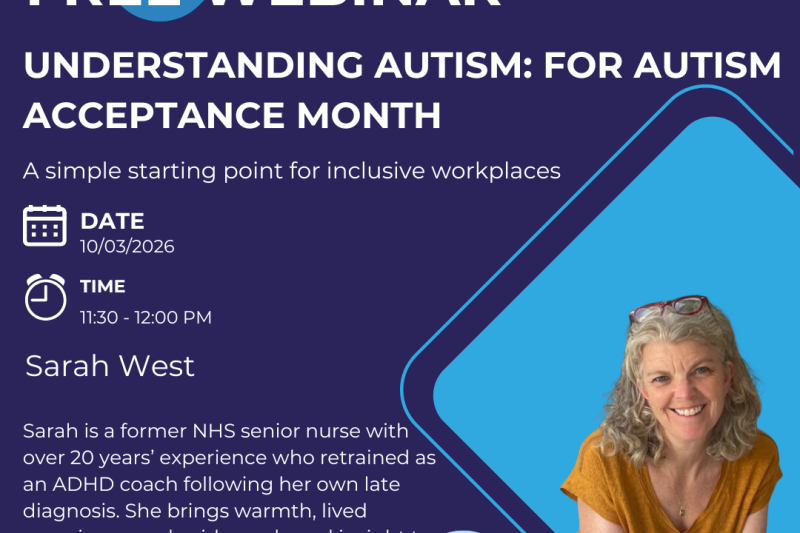
As part of Autism Awareness Month, we are hosting a short, free webinar exploring autism in the workplace in a practical and human way.
There’s no sales pitch. Just space to learn, reflect, and ask questions.
If it would be useful, you are very welcome to join us.
Autism Awareness in the Workplace. Free webinar
Date: 10 March 2026
Time: 11.30am – 12noon
Online
Please email: kirstine@bmrhealthandwellbeing.co.uk to book your space.