
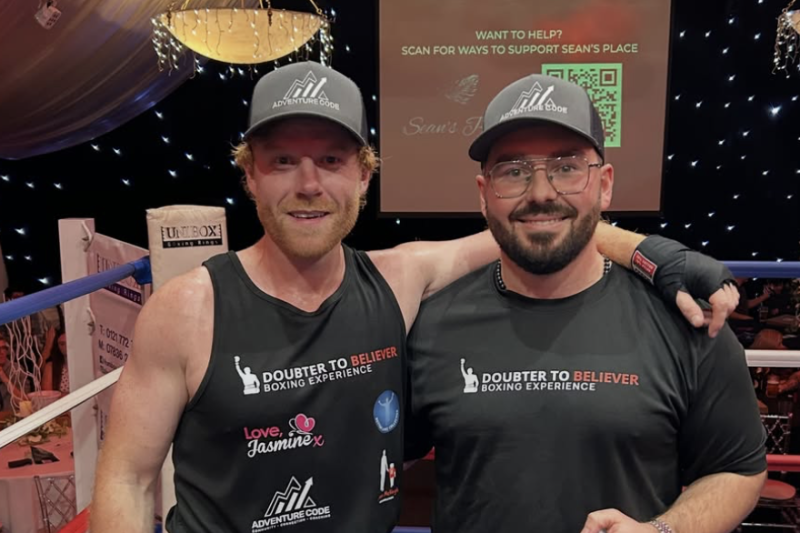
A few weeks ago, I stepped into a boxing ring for the first time in front of a crowd. By the time the final bell rang, I’d won. I’m still buzzing.
But the fight itself wasn’t what stuck with me. It was everything that came before it. And the more I’ve thought about it since, the more I’ve realised it isn’t really a story about boxing. It’s a story about the gap between where you are and where you want to be, and what actually closes it.
The fear is never about the thing itself
When I signed up for the Doubter to Believer Boxing show, getting in a ring felt genuinely daunting. Taking punches first thing in the morning and last thing at night. Sparring with people who clearly knew what they were doing. Every session felt like a reminder of how far I had to go.
But by fight night, it didn’t feel like that anymore.
Nothing magic happened. I didn’t have a breakthrough moment or a sudden surge of confidence. I just kept turning up, kept taking shots and kept going back. And slowly, the thing that once felt huge became something I felt pretty comfortable doing.
That process, that uncomfortable, unglamorous, repetitive process, is how most meaningful progress actually happens. Not in one bold leap, but in dozens of small, consistent actions that gradually shift what feels possible.
What this means for the people you lead
If you work with people, whether that’s a team of five or a workforce of five hundred, you’ll recognise this pattern immediately.
The employee who hasn’t put themselves forward for the promotion they’re clearly ready for. The manager who avoids the difficult conversation until it becomes a crisis. The team that keeps talking about the new initiative without anyone taking the first step. The person who attends every training session but never applies what they’ve learned because the moment it might actually matter feels too exposed.
This isn’t a motivation problem. It’s a confidence problem. And confidence, in a professional setting, is often misread as a personality trait rather than what it actually is: a skill that develops through repeated exposure to discomfort.
The highest performing teams aren’t made up of people who never feel uncertain. They’re made up of people who have been given enough opportunity, support and psychological safety to act despite that uncertainty. And that environment doesn’t build itself.
The confidence gap is costing more than you think
Research consistently shows that employees who lack confidence in their own capabilities are less likely to contribute ideas, less likely to flag problems early and less likely to take the initiative that drives real growth. The cost rarely shows up on a spreadsheet, but it shows up everywhere else: in missed opportunities, in slow decision-making, in the talent that quietly disengages before eventually leaving.
The irony is that most organisations invest heavily in skills training while significantly underinvesting in the conditions that allow those skills to actually be used. You can teach someone everything they need to know. If they don’t believe they can do it, or don’t feel safe trying, the training doesn’t land.
Most people aren’t avoiding a boxing ring
For most of us, the ring looks different. It’s the pitch you’ve been refining for months but haven’t sent. The restructure conversation you know needs to happen. The partnership you keep meaning to pursue. The idea you’ve floated quietly in meetings but never properly backed.
Those moments don’t come with a crowd or a corner team. But they take just as much nerve. And the fear of them is nearly always worse than the doing. The worst that usually happens is a no. A no stings for a day or two. Wondering “what if” can follow you for years, and in business, it can follow your organisation too.
The lesson from the ring
Confidence isn’t a personality trait. It isn’t something certain people are born with and others aren’t. It’s built through repetition, through showing up when it’s uncomfortable, through taking the shot even when you’re not sure it’ll land.
The most effective leaders I’ve come across understand this intuitively. They create moments for their teams to stretch. They normalise imperfect first attempts. They make it safe to try something and not quite get it right, because they know that’s where real development lives. They don’t wait for their people to feel ready. They create the conditions that make readiness possible.
The ring reminded me of all of this. And it’s a reminder I think a lot of us need right now.
So here’s the question
What’s the one thing your business has been putting off because it might not go perfectly?
What’s the conversation your team needs to have that keeps getting moved to next quarter? What’s the decision sitting in a meeting room that everyone knows needs to be made?
Pick one. Take the first step. It doesn’t have to be perfect. It just has to happen.
The first action is always the hardest. Everything after that gets easier.
The next community hike is Saturday 5th December and can be booked onto via this link https://go.adventurecodeuk.com/community-hike